
Garment Supply Chain Management for Apparel Brands: Sourcing to Delivery at Gavitex
For an apparel brand sourcing from Vietnam, garment supply chain management is not one step — it is the sequence of decisions that runs from raw material sourcing through sampling, production planning, manufacturing, quality control, packing, and export. This page walks through how that sequence works with Gavitex, stage by stage, so international buyers — from the United States, Canada, the United Kingdom, Australia and beyond — know what to expect before committing to a production partner.
What garment supply chain management means for apparel brands
A garment supply chain covers every stage between a brand’s design intent and a finished, shipped order: fabric and trim sourcing, sample development, production scheduling, cutting and sewing, quality control, packing, and logistics to the buyer’s destination market. Managing it well means each stage is planned and checked before the next one starts, so problems are caught early rather than discovered in a finished shipment. For a brand working with a Vietnam-based manufacturer like Gavitex, understanding this sequence — and where visibility and communication happen along the way — is part of evaluating whether a factory is a fit, not just what it can produce.
Raw material and fabric sourcing
Vietnam’s garment sector benefits from a dense regional ecosystem of yarn, knitting, dyeing, trims, and logistics partners built up around its manufacturing hubs. That density is what allows a factory like Gavitex to source fabric and trims that match a brand’s tech pack — fiber content, fabric weight, and finish — while keeping lead times realistic.
How fabric and trims are selected and verified before production
Sourcing starts from the buyer’s tech pack: yarn counts, stitch densities, and any performance requirements — stretch recovery, wash-fastness, colorfastness — are reviewed before fabric is committed. Risks, such as a fiber blend that won’t hold its shape or a trim that won’t survive the wash cycles a brand specifies, are flagged at this stage rather than after cutting has started. This is also where lab-level checks on shrinkage and colorfastness begin, continuing through to pre-production approval later in the process.
Trims and hardware — zippers, buttons, drawcords, care labels, and brand labels — go through the same review as fabric, since a mismatched trim can hold up an otherwise-ready order as easily as a fabric issue can. Where a brand specifies a particular supplier or certification for a trim, that requirement is carried through sourcing rather than substituted without sign-off; where a brand hasn’t specified one, Gavitex sources against the tech pack’s stated performance requirement instead of guessing at intent.
Sample development and approval

Sampling is where a tech pack becomes a physical garment for the first time, and where most of the back-and-forth between brand and factory happens. Gavitex builds fit samples to confirm fabric, trims, and construction match what was specified, then works through fit rounds with the buyer until a garment is approved. For performance or fitted categories, this includes tuning details like compression zones or stretch recovery against comfort — the kind of adjustment that is far cheaper to make on a sample than after a bulk cut.
What happens between a tech pack and an approved sample
After the first fit sample, a pre-production (PP) sample follows once styling is locked. The PP sample is what actually governs the bulk run: workmanship, shade bands, shrinkage tolerances, and finishing specs are documented against it, so “the bulk should match the sample” is a checkable standard rather than a hope. Sampling cycles move fastest when the tech pack is complete before the first sample is cut — incomplete specs are the most common cause of delay at this stage.
Production planning and scheduling
Once a PP sample is approved, the order moves into a production schedule. That means blocking machine and cutting capacity, sequencing colors and styles to reduce changeover time between runs, and confirming that fabric and trims will be in-house before the cutting date — not after it. For brands managing multiple styles or drop dates, this is the stage where a factory’s planning discipline shows up as a reliable delivery date rather than a moving target.
How order volume, fabric lead time, and factory capacity are sequenced
Planning has to account for two lead times at once: how long fabric and trims take to arrive, and how much cutting and sewing capacity the order needs relative to what else is already scheduled. Flexible starting points — beginning with a workable minimum order quantity and stepping unit costs down as volume increases — are standard practice among Vietnam-based manufacturers, and Gavitex plans capacity in blocks in advance so a confirmed order is not competing for machine time it was not scheduled for.
Manufacturing: cutting, sewing, assembly
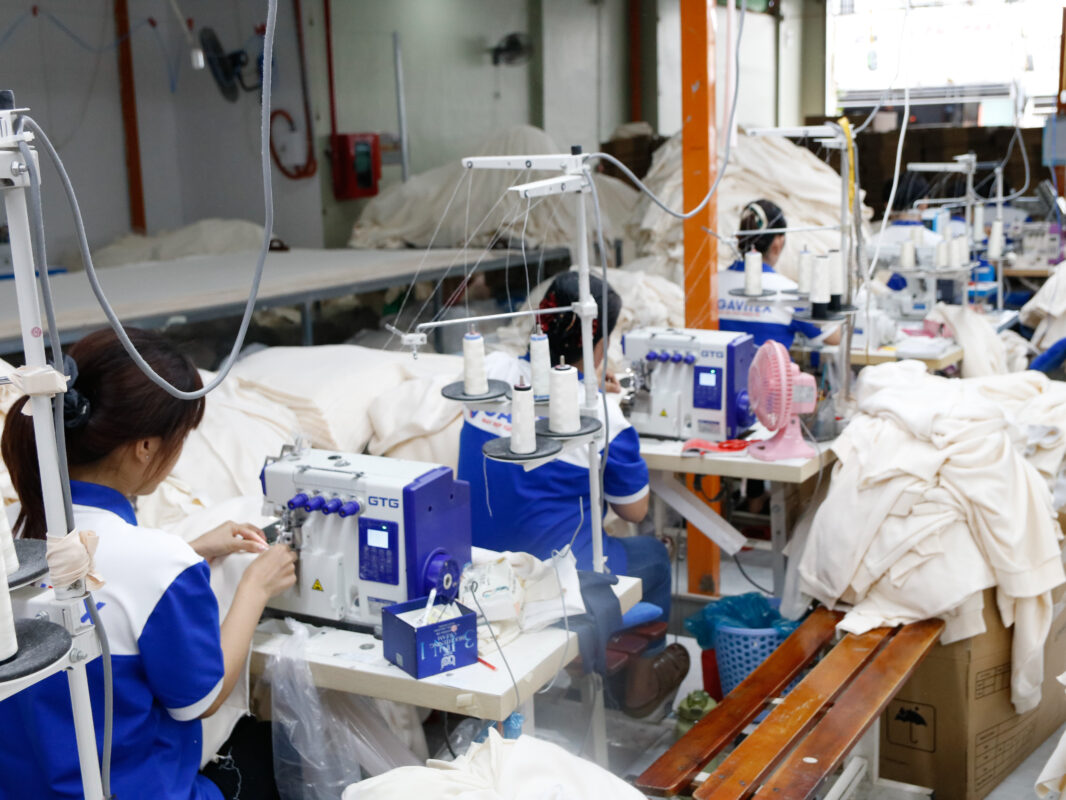
Bulk production begins with cutting, followed by sewing and assembly, and — for most categories — a finishing step such as pressing, trims, and labeling before garments are packed. Checkpoints are placed across this stage, not only at the end: cutting accuracy, in-line sewing quality, and finishing are each checked as the run progresses, so a defect pattern is caught while only a portion of the order is affected, rather than after the full run is complete.
For brands running more than one style or colorway in the same order, sequencing matters as much as the sewing itself: color and style changeovers are planned in advance so a line isn’t stopped mid-run to wait on a fabric roll or a trim delivery that should have already been staged. This is the same planning discipline described above, applied at the machine level rather than the calendar level.
Quality control checkpoints

Quality control at Gavitex runs in layers rather than as a single final check: fabric is inspected on arrival, in-line checkpoints run across cutting, sewing, finishing, and packing during the bulk run, and a final inspection is carried out before goods are released to a forwarder. This layered approach is built around AQL (Acceptable Quality Limit) sampling logic, with the goal of catching issues at the earliest stage they can appear rather than relying on a single inspection to catch everything.
Where QC happens across the process, not only at the end
Concretely, that means incoming fabric inspection before cutting; in-line checks during sewing and assembly; a final AQL inspection before packing is signed off; and documentation — shade bands, shrinkage, and finishing specs carried over from the PP sample — used as the reference standard at each stage, not just the original tech pack. A buyer who wants visibility into this can expect it to be reportable, not just asserted.
Packing and finishing for retail and export
Once garments pass final inspection, packing follows the buyer’s own routing guide: size labels, hangtags, barcodes, polybags, and cartons are prepared to the specification the buyer provides, along with the paperwork required for that shipment. Photos of packed goods are typically shared before shipment so a buyer can verify finishing and packing details without needing to be on-site.
Logistics, export coordination, and lead-time visibility
On the logistics side, Gavitex works with a buyer’s chosen freight arrangement — FOB (Free on Board) or EXW (Ex Works) are both supported, depending on how a brand manages its own freight forwarding — and hands off completed, inspected, carton-marked goods to the buyer’s forwarder at that point.
What buyers can expect to know, and when, about their order’s status
Lead-time visibility matters as much as the lead time itself for an international buyer who is not on the factory floor. The stages above — sampling, PP approval, production start, in-line QC, final inspection, and handover to the forwarder — are natural checkpoints where a buyer can expect a status update, rather than silence between order placement and a shipment notice. Brands sourcing internationally should expect to ask for, and receive, an update at each of these points as a normal part of working with a manufacturer, not a special request.
Supplier coordination and communication with international buyers
Because most of a brand’s team is not physically at the factory, communication is part of how supply chain risk gets managed, not a separate courtesy. That means surfacing a problem — a fabric delay, a fit issue found in sampling, a capacity conflict — as soon as it is identified, rather than after it has already affected a delivery date. For time-zone-separated buyers, that also means being reachable and responsive outside a single overlapping business-hours window, and communicating in terms a non-technical brand team can act on, not only technical production language.
Risk management in the garment supply chain
The most common failure points in a garment supply chain are predictable: a fabric or trim delay, a sample that needs more rounds than planned, or a capacity conflict when multiple orders compete for the same production window. Managing that risk starts earlier than most brands expect — at the sourcing and tech-pack review stage, where technical risks are meant to be flagged before sampling begins, not discovered mid-production. Where risks do surface later, the layered QC and checkpoint structure described above is what limits how much of an order is affected before a problem is caught, rather than eliminating the possibility of a problem altogether — no manufacturer can honestly promise zero risk, only a process that catches issues early and communicates them clearly.
A practical example: if a fabric shipment arrives short or with a shade variation outside tolerance, that is caught at incoming inspection, before cutting — not after garments are already sewn. The order can then be re-sequenced around the delay while a replacement or correction is sourced, rather than the whole run stalling. The cost of catching a problem is always lower the earlier it’s caught; that’s the practical reason checkpoints are spread across the process instead of concentrated at the end.
Frequently asked questions
What does end-to-end supply chain management include when working with Gavitex?
It covers fabric and trim sourcing, sample development and approval, production planning and scheduling, cutting and sewing, layered quality control, packing to your routing guide, and handover to your freight forwarder — each stage checked before the next begins.
How is fabric and trim sourced and verified before a production run starts?
Sourcing starts from your tech pack — yarn counts, stitch densities, and performance requirements are reviewed, and risks are flagged before fabric is committed. Incoming fabric is inspected on arrival, ahead of cutting.
How much lead time should I plan for, from sample approval to shipment?
Lead time depends on your style complexity, fabric availability, and order volume, so we do not quote a single figure here — but sampling moves fastest when your tech pack is complete before the first sample is cut, and production is scheduled in blocks once your PP sample is approved. Ask for a lead-time estimate specific to your style and quantity.
How are quality checks handled throughout production, not just at the final inspection?
Quality control is layered: incoming fabric inspection, in-line checkpoints across cutting, sewing, finishing, and packing, and a final AQL inspection before goods are released to your forwarder.
How does Gavitex communicate order status and delays to international buyers?
Sampling, PP approval, production start, in-line QC, final inspection, and forwarder handover are treated as natural update points. If a delay or issue comes up — a fabric delay, a fit issue, a scheduling conflict — it is raised as soon as it is identified rather than after it affects your delivery date.
What happens if there is a delay or issue with a supplier or material?
The earlier a risk is flagged, the less of an order it affects — which is why technical review happens at the sourcing and tech-pack stage, and why checkpoints run across production rather than only at the end. When something does come up, you are told directly rather than finding out once it fails inspection.
Can Gavitex support a smaller brand that’s placing its first order, not just large-volume buyers?
Yes — flexible starting minimum order quantities are part of how Gavitex works with newer brands, with unit costs stepping down as volume increases on repeat or larger orders. The same sourcing, sampling, planning, and QC process described on this page applies regardless of order size; it’s the scale of production scheduling, not the process itself, that changes with volume.
Work with Gavitex on your supply chain
If you are evaluating manufacturers for an upcoming order, or want to understand how a specific step above would work for your product, contact Gavitex to talk through your tech pack, timeline, and volume.
Related reading: for a broader look at Gavitex as a manufacturing partner, see Clothing Manufacturers in Vietnam; for a directory-style comparison across factories, see List of Clothing Manufacturers in Vietnam; if your order fits a cut-make-trim arrangement, see CMT Garment Factory; and for OEM/ODM development support, see Custom Clothing Production.